Poddupodupu Duppi
(The Dawn's Deer)
First Feature | Writer, Director, Producer | Fiction
Genre: Drama
Duration: 90 - 100Mins
Language: Telugu
Logline :
“A quest for a deer, undertaken by Santhu (9) and his elder sister Ganga (13), abruptly halts when Ganga experiences menarche, leading them into the harsh realities of growing up, where innocence collides with silence, ritual, and the yearning for freedom.”
Synopsis :
In a Telangana village, 13-year-old Ganga and her 9-year-old brother Santhu find joy in the rhythms of rural life, making clay dolls, chasing dragonflies, and savouring tamarind sweets. Ganga, a protective sister, shields her sensitive brother, while their mother, Swaroopa and grandmother, Yesamma, nurture their close bond. Their father, Prabhakar, works as a migrant labourer in Hyderabad. When Santhu discovers deer tracks, it sparks a dream of seeing a real deer. But their plans are shattered when Ganga experiences her first period, thrusting her into isolation behind a curtain marked by a confusing mix of Hindu and Christian rituals from their Dalit Christian household. Santhu struggles to understand the sudden divide, facing bullying and the fear of losing Ganga to marriage. As Ganga grapples with the physical and emotional upheaval, vivid dreams of a blood-soaked wedding haunt her. A tense confrontation with Yesamma leads to a heartbreaking slap from Swaroopa, witnessed by a helpless Santhu, leaving the siblings emotionally adrift in a world suddenly too vast and unforgiving.
Characters

Ganga:
Ganga is an adolescent girl who lovingly cares for her younger brother and takes on household responsibilities. Despite being aware of her family's economic struggles, she remains a free-spirited and happy schoolgirl. Witnessing domestic violence and seeing her mother suffer, Ganga realises there is more to being a woman than she initially thought. She understands that she must accept and endure the challenges ahead.

Santhu:
Santhu is a carefree, pampered child loved and forgiven by everyone in the family. His sister protects him from bullying classmates, and he lives without worries. He is a dreamer, a curious child and lives in his world. But Ganga’s menstruation disrupts his life too. When he questions what is happening to Ganga, he is met with silence and confusion.

Swaroopa:
Swaroopa is a resilient and nurturing mother who carries the weight of her family’s survival on her shoulders. Balancing tenderness with practicality, she is deeply invested in her children’s well-being, navigating the challenges of rural life with quiet strength. Swaroopa is rooted in tradition but aspires to break the cycle of oppression for her daughter, Ganga. She fiercely believes in the value of education and independence for her daughter despite societal pressures.

Yesamma:
Yesamma’s character is a layered portrayal of how deeply ingrained patriarchy manifests within women, shaping their roles as both victims and enforcers of oppressive traditions. She embodies a generational adherence to societal norms, shaped by years of internalising the patriarchal systems that have governed her life. She is protective of Santhu, offering him comfort and assurance when he feels isolated or confused. Her practical approach to life reflects her years of experience, but her moments of tenderness reveal an unspoken empathy for the struggles Ganga and Swaroopa face.
Team
Editor: Raghavender Vuppuganti is a highly skilled film editor and an alumnus of the prestigious Film and Television Institute of India (FTII), Pune, where he completed his Post-Graduate Diploma in Film Editing. His notable work includes editing the critically acclaimed feature film In Retreat, which received international recognition with its official screening at the Cannes Film Festival in the ACID section.
Cinematographer: Vinod K Bangari is a cinematographer and filmmaker with a background in Fine Arts, holding a BFA in Painting. His passion for cinema led him to the Film and Television Institute of India (FTII), where he worked across 16mm, 35mm, and digital formats. His work has been screened and awarded at film festivals such as the Dhaka International Youth Film Festival, the Urus International Film Festival (Italy), the DMCS National Short Film Festival, the Vishwarang International Film Festival, and the London Indian Film Festival.
Sound: K Bujanga Rao is an alumnus of the prestigious Film and Television Institute of India (FTII), is a versatile and detail-oriented sound recordist, designer, and mixing engineer with a passion for creating immersive sonic experiences. From clean on-location recording to intricate soundscapes and final mix, he brings both technical precision and creative sensibility to every project. Experienced across film, TV, advertising, and digital media, he combines expertise with a strong storytelling instinct to elevate the auditory experience. His work has been screened at the Dharamshala International Film Festival.
Themes
Belonging to a Dalit-converted Christian community, the family’s story reflects a blend of caste and religious influences, grounding their experiences in a deeply rooted belief system and long-standing traditions.
Domestic violence is another critical theme. The film captures the devastating impact of violence on children, shaping their perceptions and instilling fear and confusion.
Masculinity is explored through Santhu’s innocent eyes. His idealisation of his father is shattered when he witnesses the abuse, leaving him conflicted about what it means to be a man.
The film also addresses the complex dynamics of women oppressing women. Despite Swaroopa’s desire for Ganga to pursue education, both she and Yesamma enforce restrictive rituals, showing how patriarchal norms are perpetuated even by those who suffer under them.
Space

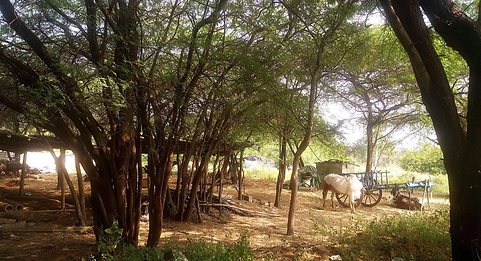


Look Book
Lighting
Natural Light: The film predominantly uses natural light to evoke realism. Morning and daytime scenes feature soft, diffused light, symbolising fleeting moments of peace and innocence.


Nighttime scenes, such as Ganga’s confinement, are bathed in low-key lighting, creating shadows that mirror her feelings of isolation and vulnerability.


Tone


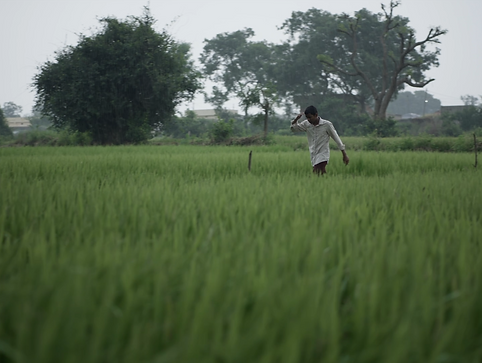


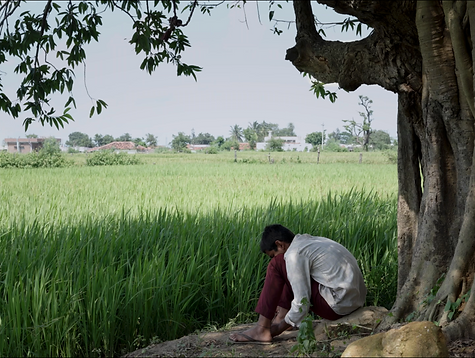
*The accompanying images are screen grabs from the pilot film. These visuals are intended to represent the film's look, tone, and style and are included as part of this presentation solely for illustrative and reference purposes. All images are subject to copyright and are the intellectual property of the filmmaker and production team. Any unauthorised reproduction, distribution, or use of these images is strictly prohibited.*
Sound :
The film embraces the natural sounds of rural Telangana, including rustling leaves,
chirping birds, buzzing dragonflies, flowing water from the lake, and the distant hum of village life. Sounds of everyday activities, like the grinding of spices, the rhythm of
footsteps in the fields, or the creak of an old wooden door, provide an auditory
texture. Silence is used deliberately during emotionally charged moments, such as
Ganga’s isolation or the domestic violence sequence, to amplify the tension and allow
the audience to focus on the rawness of the characters' experiences. A very minimalist approach to the music, with a single instrument.
Teaser of the Pilot film
Director Statement :
Ganga and Santhu’s story is one of resilience and hope. I want to tell a story about my culture, language, and women's resilience. This film is deeply personal to me, drawing from my own experiences in the place where I was born and live. Through Santhu's lens, I aim to explore a boy's journey of questioning and understanding womanhood. I hope to offer the audience insight into the complexities of growing up in a traditional setting, where personal aspirations often clash with societal expectations. Although the film is deeply rooted in the context of rural Indian culture, its themes are universal, seeking to connect with audiences globally by highlighting shared human experiences. The film aims to offer a poignant and authentic portrayal of rural life and the struggles that young individuals face in traditional settings by emphasising the importance of education and the need for cultural introspection.
Director's Biography :
Bandari Sai Smaran is an independent filmmaker from Hyderabad, Telangana, India. He has completed his Master’s in Film and Video Communication at the National Institute of Design (NID), Ahmedabad. His graduation film, Allo Neredallo (2025), a short fiction film, is supported by the Ford Foundation Grant, which was also selected and screened at the 48th Poitiers Film Festival, France. His filmmaking journey began with an undying interest in narration, which initially found expression through photography and has since evolved into films. His storytelling is deeply influenced by the nuances of the ordinary, the small, delicate moments that often go unnoticed. His cinematic gaze is rooted in the culture he comes from, shaping his sensitivity towards the stories he tells.
Thank you for exploring our vision for the film.
If this story resonates with you and you’re inspired to be part of this journey, we’d love to
collaborate and bring this world to life together.
To know more about my work or to connect, feel free to reach out
Let’s build this world and share its story with the world. Come, Let's make Cinema!
